Hang-Up, Bridging or Ratholing? How to Diagnose a Silo Blockage
Material has stopped flowing from your silo. But what is actually happening inside it?
The immediate assumption may be that the outlet is blocked. In reality, the obstruction could be much higher up. A self-supporting bridge may have formed above the discharge point, material could be moving through a narrow rat-hole while remaining lodged against the walls, or years of build-up may have gradually reduced the silo’s usable capacity.
Recognising the likely type of silo blockage can help you understand the scale of the problem and choose the safest way to resolve it.
What is a silo blockage?
A silo blockage is a build-up, compaction or flow obstruction that restricts or completely stops the discharge of stored material. Common types include material hang-up on the silo walls, bridging above the outlet, ratholing through the centre of the stored material and plugging at the discharge point.
Not every blockage results in a complete and immediate loss of flow. Some develop gradually, reducing storage capacity and affecting discharge long before the silo stops working altogether.
That makes changes in flow, throughput and usable capacity important early warning signs.
What type of silo blockage do you have?
Although the terms are sometimes used interchangeably, hang-up, bridging and ratholing describe different material-flow problems.
| Type of blockage | What is happening? | Typical warning sign |
|---|---|---|
| Material hang-up | Product remains attached to the silo walls | Usable capacity gradually reduces |
| Bridging or arching | A self-supporting arch forms above the outlet | Discharge stops suddenly |
| Ratholing | Material flows through a narrow central channel | Some flow continues, but large quantities remain in the silo |
| Outlet plugging | Compacted material obstructs the discharge point | The outlet or feeder will not discharge |
| Caking | Material hardens into deposits or solid lumps | Flow becomes progressively less reliable |
The symptoms provide useful clues, but it is important not to treat them as a substitute for a proper assessment. Silo design, material characteristics and operating conditions can all influence how a blockage presents itself.
What is material hang-up?
Material hang-up occurs when product adheres to the internal walls rather than discharging cleanly.
This may begin as a relatively thin layer of residue. As more material sticks to it, however, deposits can become thicker and harder. Eventually, substantial areas of the silo may be covered.
Common signs include:
- A gradual reduction in storage capacity
- Less material being recovered than inventory records suggest
- Increasingly irregular discharge
- High-level readings that do not match the amount of material flowing out
- Repeated build-up in the same area of the silo
Wall build-up may be caused by moisture, condensation, fine cohesive particles, rough internal surfaces or material remaining in storage for extended periods.
If it is not removed, hang-up can contribute to ratholing, cross-contamination and more serious flow restrictions.
What is silo bridging?
Silo bridging, also known as arching or doming, occurs when stored material forms a self-supporting structure across the silo or hopper.
The bridge holds the material above it in place, preventing it from reaching the outlet. This can cause discharge to stop very suddenly, even though the silo still contains a substantial volume of product.
A bridge can be particularly hazardous because there may be an apparently empty space beneath a large quantity of retained material. If the structure collapses without warning, the material can descend with enormous force.
Potential warning signs include:
- A sudden and complete loss of discharge
- The feeder running while no material reaches it
- Normal or high inventory readings despite no output
- Repeated attempts to restart the discharge system having no effect
- Flow resuming suddenly before stopping again
Bridging is commonly associated with cohesive powders, moisture ingress, compaction, insufficient outlet dimensions or material that has consolidated during prolonged storage.
What is ratholing in a silo?
Ratholing, sometimes written as rat-holing, occurs when material discharges through a narrow vertical channel while the surrounding product remains stationary.
From outside the silo, it may appear that material is still flowing. However, only the product immediately above the channel is moving. Large quantities can remain lodged against the walls.
Eventually, the central channel may empty and flow can stop completely.
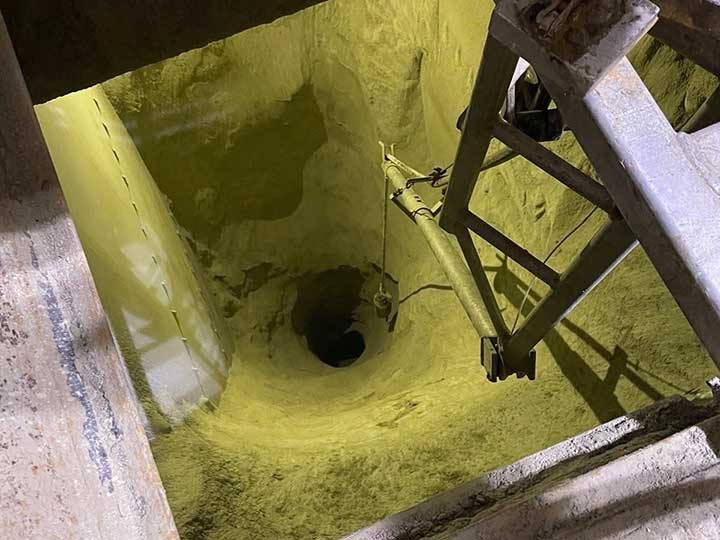
Typical indications of ratholing include:
- Continued but lower-than-expected discharge
- A significant reduction in usable or “live” capacity
- Stored material remaining in the silo for much longer than expected
- Inaccurate assumptions about how much product is left
- Flow stopping once the central channel has emptied
Ratholing is often connected with funnel-flow conditions, where only some of the material moves during discharge. It can lead to product deterioration, contamination between batches and progressively harder wall deposits.
What is outlet plugging?
Sometimes the obstruction is exactly where it first appears to be: at or immediately above the discharge point.
Material can compact around the outlet, harden after exposure to moisture or form large lumps that the opening cannot accommodate. Problems with a feeder, valve or discharge mechanism may also produce symptoms that resemble a material blockage.
Because similar symptoms can have different causes, the discharge equipment and the condition of the stored material should both form part of the assessment.
How can you diagnose a silo blockage safely?
A safe diagnosis should begin with operating information and observations made from outside the silo.
Start by asking:
- Did flow stop suddenly or deteriorate gradually?
- Is there no discharge at all, or is some material still moving?
- Has the silo’s usable capacity reduced over time?
- Do stock records agree with the quantity recovered?
- Has the material been exposed to moisture or condensation?
- Has it remained in storage longer than usual?
- Has this silo experienced similar problems before?
- Are the feeder, valve and discharge mechanism operating correctly?
A sudden loss of flow may point towards bridging or outlet plugging. Gradually falling capacity is more consistent with wall build-up or ratholing. Intermittent discharge could indicate material repeatedly collapsing into a central channel or a developing restriction around the outlet.
External observations may also provide warning signs. Unusual noises, vibration, deformation or bulging should never be ignored, as they may indicate uneven loading or another structural concern.
Most importantly, investigation must not expose people to the retained material.
A blocked silo can contain unstable retained material that may release without warning. Workers should never enter a blocked silo, stand beneath suspected bridging or attempt improvised clearance without an assessed system of work.
Workers should never enter a blocked silo, stand beneath suspected bridging or use improvised methods such as striking the walls without an assessed system of work. A blockage can release suddenly, and a silo remains a confined-space environment even when it appears to be empty.
What causes silo blockages?
Silo flow problems rarely have one universal cause. They normally result from an interaction between the stored material, the silo and the way the system is operated.
Material characteristics
Fine powders and cohesive materials are more likely to stick together and form stable arches. Particle shape, size distribution, density and compressibility can also affect how freely a product flows.
Even material that normally discharges reliably can behave differently when its condition changes.
Moisture and condensation
Moisture ingress can transform a free-flowing powder into a compacted or hardened mass. Temperature changes may also create condensation inside a silo, particularly when warm material enters a colder vessel or weather conditions fluctuate.
In industries handling cement, lime, ash, minerals or aggregates, relatively small amounts of moisture can create substantial hardened deposits.
Silo and hopper design
Outlet size, hopper angle, wall friction and internal surface condition all influence material flow.
In a mass-flow silo, the aim is for all the stored material to move during discharge. In a funnel-flow silo, only a central area may move while material around the walls remains stationary. Funnel flow is therefore more closely associated with ratholing, segregation and material remaining in storage for extended periods.
Repeated blockages in the same silo may indicate an underlying flow or design issue rather than cleaning alone.
Operating conditions
Blockages can also be encouraged by:
- Extended storage periods
- Infrequent or inconsistent discharge
- Overfilling
- Changes in the product being stored
- Inappropriate use of flow aids
- Residue left behind between batches
- Inadequate inspection and cleaning
- Material being loaded in an unexpectedly wet condition
Clearing the immediate obstruction may restore production, but recurring problems should prompt a wider review of material handling and maintenance arrangements.
Why silo blockages should not be ignored
A silo does not need to be completely blocked to create an operational problem.
Material build-up can:
- Reduce usable storage capacity
- Restrict throughput
- Cause inaccurate stock calculations
- Interrupt production
- Affect consistency at the discharge point
- Allow older material to deteriorate
- Increase the risk of cross-contamination
- Place uneven loads on the structure
- Create dust and confined-space hazards
- Make eventual cleaning more difficult
There is also a risk of retained material collapsing unexpectedly. A bridge or hardened deposit can release without warning, particularly if it is disturbed using an unsuitable method.
Acting early normally provides more options. As discussed in our guide to planned versus reactive industrial cleaning, routine inspection and cleaning can prevent a manageable accumulation from becoming a production-critical blockage.
How are silo blockages safely removed?
There is no single method suitable for every blocked silo. The correct approach depends on:
- The material being stored
- The type and location of the blockage
- Whether the material is loose, compacted or set solid
- Silo size and construction
- Available access points
- The amount of retained material
- The possibility of recovering or reusing it
- The condition of the structure and discharge equipment
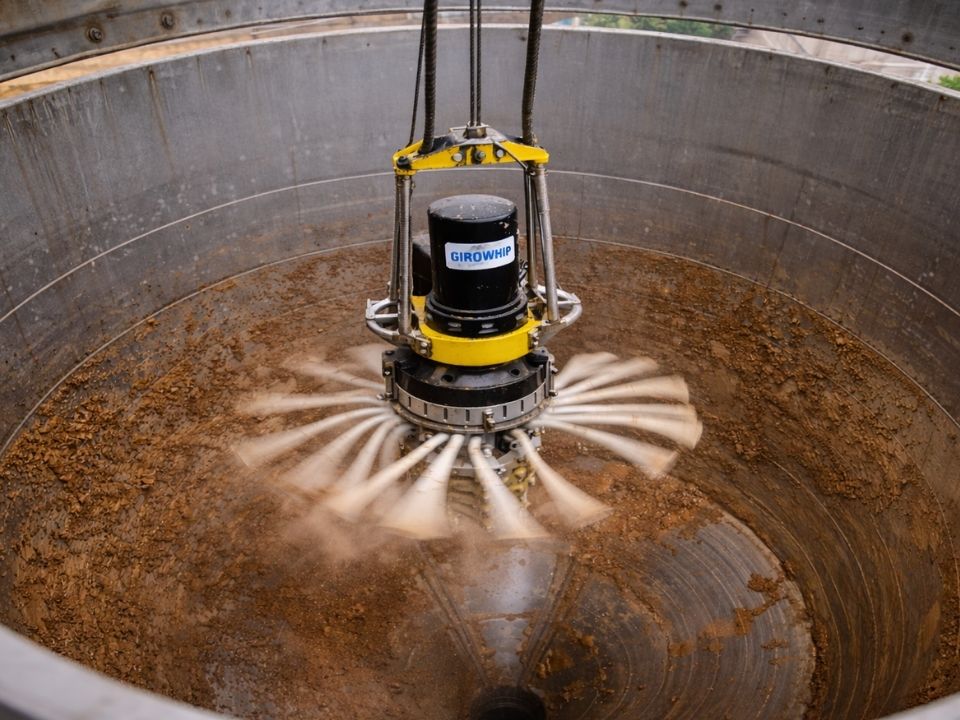
NQIS assesses these factors before recommending an appropriate silo cleaning method.
Non-entry mechanical cleaning
Where conditions allow, remote mechanical systems can break down material from outside the vessel.
A Gyro Whip uses a revolving cleaning head to which different whips or chains can be fitted depending on the material, to dislodge compacted product, hardened wall build-up, ratholes and other structural blockages. The equipment can be controlled from outside the silo, reducing the need to expose workers to confined-space and engulfment hazards.
Non-entry does not mean risk-free. Isolation, access, falling material and dust still need to be controlled through an appropriate plan and system of work.
Removing the released material
Breaking up a blockage is only part of the job. The dislodged product must also be removed or transferred in a controlled way.
High-powered DISAB vacuum tanker equipment can remove large volumes of loose material through flexible hoses and collect it within the vehicle’s tank.
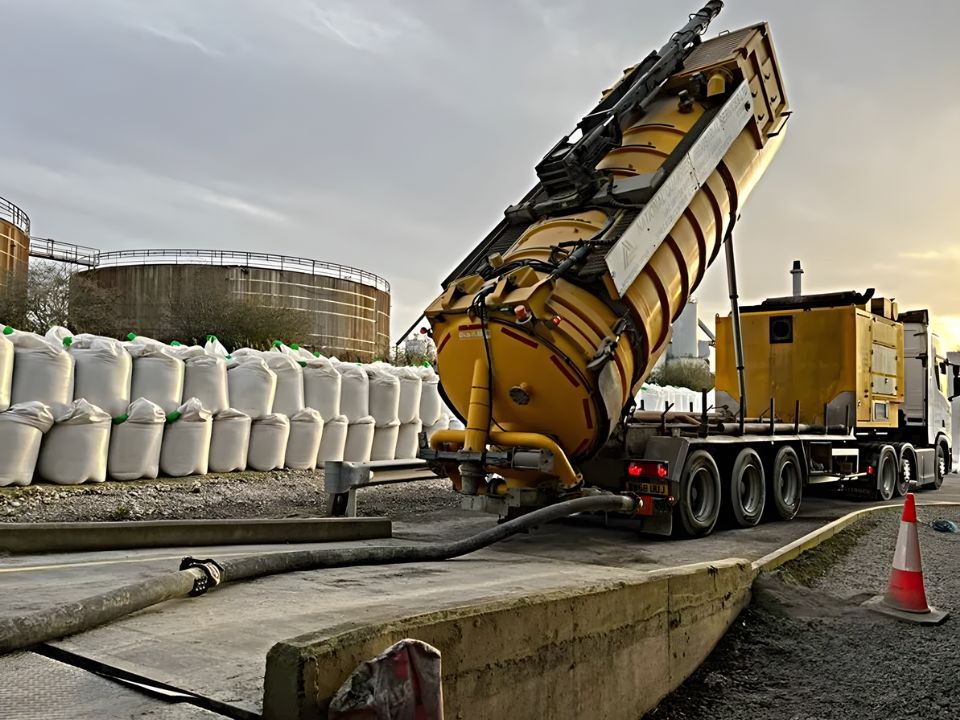
Depending on the application, this can:
- Support silo emptying before intensive cleaning begins
- Remove material as it is dislodged
- Reduce manual shovelling and handling
- Reach difficult or restricted areas
- Recover suitable material for reuse
- Help control dust at the point of collection
Our guide to how DISAB vacuum systems work explains their role in silo emptying, blockage clearance and high-volume material recovery in more detail.
Confined-space entry
Some severe or complex blockages may require people to enter the silo. This should only take place where it has been properly assessed and cannot reasonably be completed using a suitable non-entry method.
Confined-space work requires competent personnel, formal isolation, atmospheric monitoring, an entry permit, suitable equipment and a planned rescue arrangement. It is specialist work, not simply an extension of routine cleaning.
Can silo blockages be prevented?
Not every blockage can be eliminated, but good monitoring and maintenance can significantly reduce the likelihood of an unexpected failure.
Useful measures include:
- Monitor changes in discharge rate and consistency
- Compare actual recovered volumes with inventory readings
- Investigate unexplained reductions in usable capacity
- Prevent water ingress and manage condensation
- Check discharge equipment and flow aids
- Avoid leaving susceptible materials static for extended periods
- Inspect accessible internal surfaces during planned shutdowns
- Remove build-up before it becomes heavily compacted
- Arrange planned industrial cleaning around maintenance periods
- Investigate the underlying cause of recurring blockages
Cleaning should not be viewed only as a response to complete flow failure. Planned intervention is generally easier to schedule and manage than emergency work after production has already stopped.
When should you call a silo cleaning specialist?
Specialist advice should be sought when:
- Material flow has stopped or become unpredictable
- Bridging or extensive ratholing is suspected
- The amount of retained material is unknown
- Hardened deposits are affecting usable capacity
- The obstruction cannot be accessed safely
- There is a risk of a sudden material collapse
- Previous attempts to restore flow have failed
- The blockage keeps returning
- Non-entry cleaning or high-capacity extraction may be required
Useful information to provide includes the silo dimensions, construction, stored material, approximate volume, access arrangements, discharge symptoms and whether moisture ingress is suspected. Photographs, drawings and previous cleaning records may also help with the initial assessment.
Need help with a blocked silo?
NQIS provides specialist silo cleaning and blockage removal for quarries, cement plants, manufacturing facilities and other bulk-material operations throughout the UK.
From hardened deposits and bridging to ratholing and reduced silo capacity, our teams can combine Gyro Whip cleaning with high-capacity DISAB vacuum equipment to safely break down and remove retained material.
Frequently asked questions
What is the difference between bridging and ratholing?
Bridging creates a self-supporting arch above the silo outlet and may stop discharge completely. Ratholing leaves a narrow central channel through which some material can continue to flow while substantial quantities remain stationary against the silo walls.
Can a silo still discharge if it is ratholing?
Yes. A ratholing silo may continue to discharge through its central channel, but at a reduced or inconsistent rate. Once the material above the channel has emptied, flow may stop even though significant quantities remain inside the silo.
Why does material stick to silo walls?
Common causes include moisture, condensation, cohesive fine particles, compaction, rough internal surfaces and extended storage. Residual deposits can also provide a surface to which subsequent material adheres.
Can a silo blockage be removed without man-entry?
In many cases, yes. Remote mechanical cleaning and vacuum extraction can remove wall build-up and blockages from outside the silo. The appropriate method depends on the material, silo design and severity of the obstruction.
How long does silo blockage removal take?
The timescale depends on the size and design of the silo, the type and volume of the blockage, material condition and accessibility. Minor restrictions may be resolved relatively quickly, while heavily compacted or extensive blockages can require a longer programme.
How often should a silo be cleaned?
There is no universal interval. Cleaning frequency should be based on the stored material, usage pattern, previous build-up and changes in flow or usable capacity. Silos handling cohesive or moisture-sensitive materials may require more frequent inspection and cleaning.
Ready to get started?
If you have any questions about any of our services, feel free to request a FREE quote using our simple quote request form. Once we’ve received your message, one of our friendly team members will get in touch shortly to discuss your requirements in detail.


